Smart coolers vs. vending machines: what's actually different?
By Hayden9 min read
Smart coolers vs. vending machines is becoming a real decision for Vancouver buildings: the machine in the corner is up for contract renewal, and there’s now a genuinely different option. The two look superficially similar — a refrigerated cabinet selling drinks and snacks — but they work, earn and feel completely different. Here’s the whole comparison in plain English.
The short answer
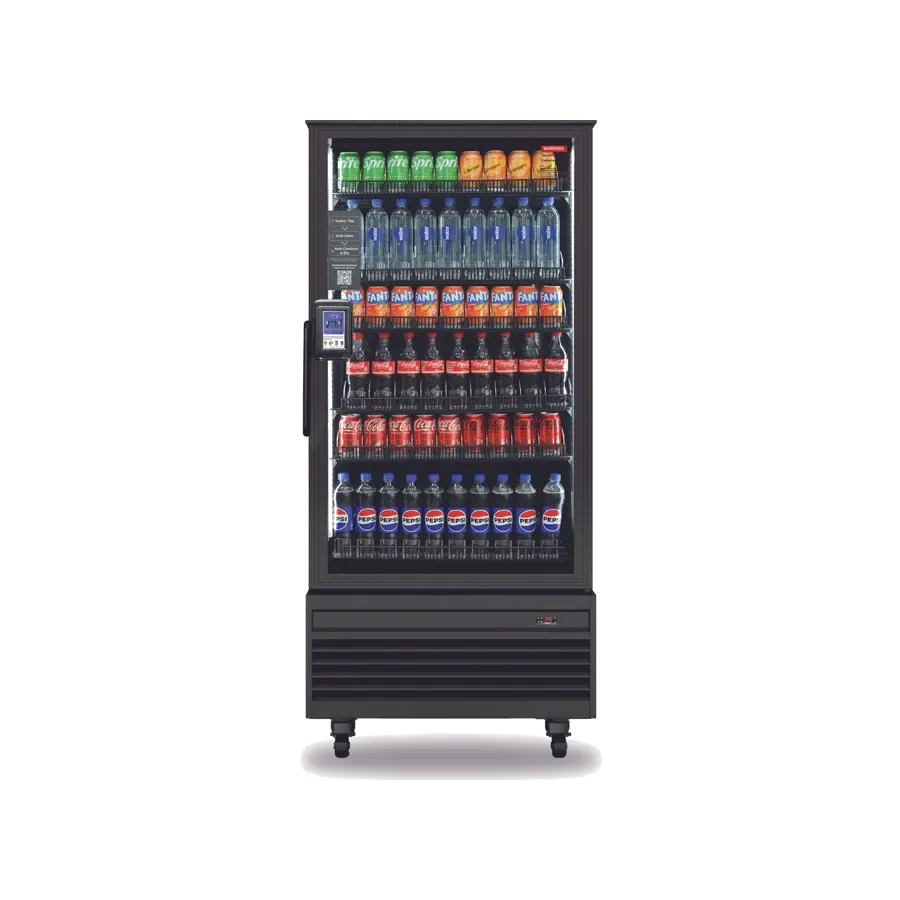
A vending machine sells one item at a time through a coil-and-drop mechanism: pay first, pick a code, hope. A smart cooler is a locked retail fridge: tap any card to unlock the glass door, pick products up like you would in a shop, and AI cameras charge you automatically for what you take when the door closes. For shoppers it’s faster and more trustworthy; for hosts it’s better-looking and better-earning; for operators it produces live data instead of guesswork.
How a traditional vending machine works
The classic machine hasn’t structurally changed since the 1980s. Products sit in metal coils behind glass. You pay (today, usually by tap), punch a code, and a motor turns the coil until your item drops into a bin. It’s a proven format with real strengths: the technology is cheap, widely serviced, and every operator in the Lower Mainland knows how to run one.
Its weaknesses are just as familiar:
- Purchases are blind. You can’t read a label, check a size, or change your mind after the coil turns.
- Mechanics fail visibly. Hung products, eaten coins, jammed coils — the machine’s worst moments happen in front of the customer.
- Selection is capped by coil widths, which is why every machine converges on the same chips-and-chocolate lineup.
- It looks like equipment. No lobby was ever improved by one, which is why property managers hide them by the service elevator.
How an AI smart cooler works
A smart cooler removes the machinery between shopper and product. The cabinet stays locked until a payment method is verified — a tap of any Interac, credit card, Apple Pay or Google Pay places a small hold, like a gas pump. The glass door releases, and from there it behaves like your own fridge: pick things up, read labels, put them back. Computer-vision cameras (assisted by shelf sensors) track exactly which items leave during the visit, and the final charge replaces the hold seconds after the door closes.
The practical consequences are bigger than the technology sounds. Because nothing needs to fit a coil, the cabinet can stock yogurt cups next to protein boxes next to kombucha. Because payment happens passively, a purchase takes about ten seconds. And because every cabinet reports its inventory in real time, restocking happens before favourites sell out rather than after complaints. We walk through the shopper experience step-by-step on our how it works page.
Side-by-side comparison
| Dimension | Vending machine | Smart cooler |
|---|---|---|
| Buying experience | Pay blind, code, coil drop | Open door, handle products, auto-charge |
| Failure modes | Jams, hung items, eaten coins | No moving parts to jam; remote fault alerts |
| Selection | Coil-shaped items only | Anything that fits a shelf |
| Payments | Coins/bills, tap on newer units | Tap only — Interac, credit, phone wallets |
| Security | Cash box attracts break-ins | Cashless, locked, camera-verified |
| Aesthetics | Backlit equipment | Retail cooler; belongs in a lobby |
| Restocking | Fixed route schedule | Telemetry-driven, before sell-out |
What each costs a host (usually the same: nothing)
Here the two formats agree: in the free placement model common across Metro Vancouver, the operator owns and services the equipment and the host pays nothing. The difference is what the host gets for that same zero. A traditional machine delivers a commodity service. A smart cooler delivers a visible amenity — something tenant-experience surveys and leasing tours actually notice — plus the option of commission on meaningfully higher sales. Industry data (largely from US markets) consistently shows self-serve markets out-earning traditional vending per customer, which is why the format is the fastest-growing corner of unattended retail; Canadian adoption of tap payment (58% of all transactions, per Payments Canada) removes the last friction that held these formats back.
One BC-specific wrinkle applies to both formats equally: under the province’s PST rules, if a machine dispenses any soda beverage, all beverages from that machine become taxable. A thoughtful operator configures around this — for instance with soda-free coolers — and prices transparently either way.
Which fits your building?
Honest guidance, since we place smart coolers, snack stores and combo micro markets for a living:
- Class A/B offices, condo lobbies, gyms, hotels: smart cooler, no contest. These are exactly the spaces where design and experience carry the decision.
- High-traffic sites (150+ people/day): a combo micro market — the selection advantage compounds with volume.
- Very small sites (<30 people/day): a traditional machine may honestly remain the economical choice — or a compact smart store where the space is brand-sensitive.
If you’re weighing the swap for a specific building in the Lower Mainland, a fifteen-minute site walk answers it faster than any article — request one here, free.
FAQ
Are smart coolers more expensive for shoppers?
Prices are comparable to convenience retail — and often feel fairer, because shoppers can read labels and check sizes before buying instead of paying blind through glass.
Do smart coolers get more theft than vending machines?
Less, in practice. The door only opens after a payment card is verified, there's no cash box to pry, and every transaction is camera-verified. Traditional machines are the ones that get rocked, pried and jammed.
Can a smart cooler replace an existing vending machine?
Usually one-for-one: a smart cooler needs roughly the same footprint and the same outlet. Many hosts make the swap when their current vending contract lapses.
Do smart coolers work without an internet connection in the building?
Yes — Tidewater's cabinets carry their own cellular connection with failover, so the building's network is never involved.
What happens if a shopper is charged incorrectly?
Every transaction is video-verified, and a QR code on the door reaches the operator directly. Genuine errors are rare and refunded quickly — a faster path than any coin-return lever ever was.